
Modular Microphysiological Platform
A modular microphysiological systems platform for building human-relevant, multi-cellular and multi-organ in vitro models — compatible with standard laboratory workflows.
Developed by Revivocell to make complex organ-on-chip biology practical, scalable, and accessible.
What is NANOSTACKS™?
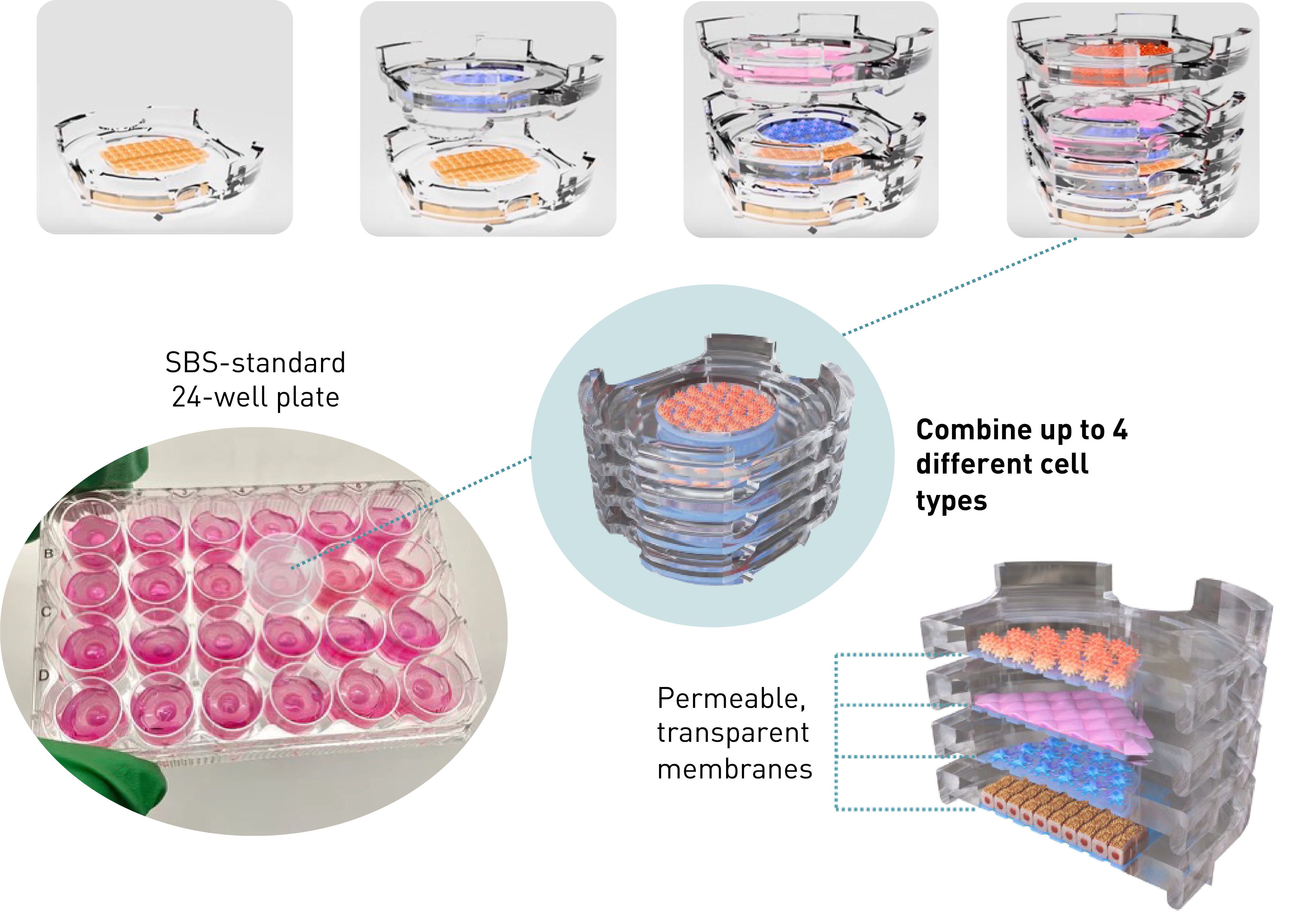
NANOSTACKS™ is a modular microphysiological systems (MPS) platform that enables human-relevant, multicellular and multi-organ tissue models within a standard SBS-format well plate.
By stacking discrete, permeable compartments, researchers can recreate controlled cell–cell communication, tissue organization, and physiological exposure without complex microfluidics. The platform integrates seamlessly with existing laboratory workflows for scalable, reproducible in vitro studies.
Why NANOSTACKS™ Is Different
NANOSTACKS™ was designed to overcome the limitations of traditional organ-on-chip and Transwell-based systems by combining modular architecture with standard laboratory compatibility.
Modular, stackable tissue compartments within a standard SBS-format well plate
Physical separation of cell types with controlled biochemical communication
Physiological fluid flow generated without pumps, tubing, or microfluidics
Imaging-first, assay-compatible design for seamless integration into existing workflows
Compatible with standard lab workflows (no pumps or complex microfluidics required)
How NANOSTACKS™ Compares
NANOSTACKS™ combines the accessibility of Transwell systems with the physiological relevance of organ-on-chip, without the equipment barriers of conventional microfluidics.
| Feature | NANOSTACKS™ | Transwell Inserts | Organ-on-Chip (microfluidic) |
|---|---|---|---|
| Architecture | Stackable compartments in standard well plates | Single porous membrane insert | Etched microchannels in PDMS/glass |
| Multi-cellular co-culture | Yes — up to 4 stacked compartments | Limited to 2 compartments (apical/basolateral) | Yes — but channel geometry constrains layout |
| Multi-organ connectivity | Yes — shared media enables organ crosstalk | No — isolated single-insert format | Yes — but requires custom chip fabrication |
| Fluid flow | Pump-free orbital shaking | Static (no flow) | Requires external pumps and tubing |
| Imaging compatibility | Widefield, confocal, high-content imaging | Limited — thick membrane obstructs imaging | Good — but chip-specific objectives needed |
| Equipment requirements | Standard lab equipment (orbital shaker) | Standard lab equipment | Specialized pumps, tubing, chip holders |
| Scalability | 24-well and 72-well SBS format | 6- to 96-well formats | Typically single-chip or low-throughput |
| Barrier modeling | Polarized epithelial and endothelial barriers | Polarized epithelial barriers | Polarized barriers with flow |
| Adoption barrier | Low — no new equipment or training | Low | High — microfluidics expertise required |
How NANOSTACKS™ Works
Build Layer by Layer
Stack up to 4 compartments per well to create physiological microenvironments.
Introduce Dynamic Flow
Orbital motion generates shear stress without pumps or tubing.
Analyze Using Standard Methods
Use standard imaging, plate readers, and molecular assays.
Physiological Fluid Flow Without Pumps or Tubing
Orbital rotation induces controlled fluid flow across stacked cellular compartments, generating shear stress without pumps, tubing, or external microfluidic hardware.
This dynamic environment enhances nutrient and waste exchange, cell-cell signaling, and overall tissue function within a simplified, scalable format.

Assay Compatibility
NANOSTACKS™ integrates seamlessly with standard laboratory equipment and analytical methods, enabling diverse experimental readouts without specialized hardware.

Microscopy & High-Content Imaging
Compatible with standard fluorescence, confocal, and automated imaging systems for morphological and functional analysis
Live-cell imaging on NANOSTACKS™ platform

Plate Reader Endpoints
Standard colorimetric, fluorometric, and luminescent assays for viability, proliferation, and metabolic activity
Quantitative endpoint measurement example

Biochemical & Molecular Sampling
Media sampling for ELISA, mass spectrometry, qPCR, and other downstream molecular analyses
Time-course biomarker sampling capability
Key Technical Specifications
| Platform type | Modular organ-on-chip / MPS |
| Plate format | 24-well SBS-standard |
| Body material | Medical-grade polycarbonate (PC) |
| Membrane material | Polyester (PETE), 10 µm |
| Membrane pore size | 0.4 µm (standard) |
| Stackability | Up to 4 levels per well |
| Working volume | 0.5–1.5 mL per well |
| Culture conditions | Static or orbital shaker–based flow |
| Imaging compatibility | Widefield & confocal microscopy |
| Sterility | Supplied sterile, ready-to-use |
The modular architecture of NANOSTACKS™ enables a wide range of human-relevant tissue configurations, from single-organ systems to complex, interacting multi-organ models.
What You Can Build with NANOSTACKS™
Single-Organ Models
Build mono-, tri-, or tetraculture configurations within a single well.
Multi-Organ Systems
Stack multiple organ compartments to investigate inter-organ communication.
Barrier & Interface Models
Create polarized epithelial or endothelial barriers for permeability studies.
Stromal & Immune Interactions
Co-culture parenchymal cells with fibroblasts, endothelial cells, or immune cells.
Disease Modeling
Incorporate diseased cell types and inflammatory signals to model pathologies.
Custom Architectures
Design purpose-built configurations tailored to your specific research needs.