Science Explainer
What is a Microphysiological System (MPS)?
A reference guide to microphysiological systems (MPS), organ-on-chip technology, and the principles underlying human-relevant in vitro research.
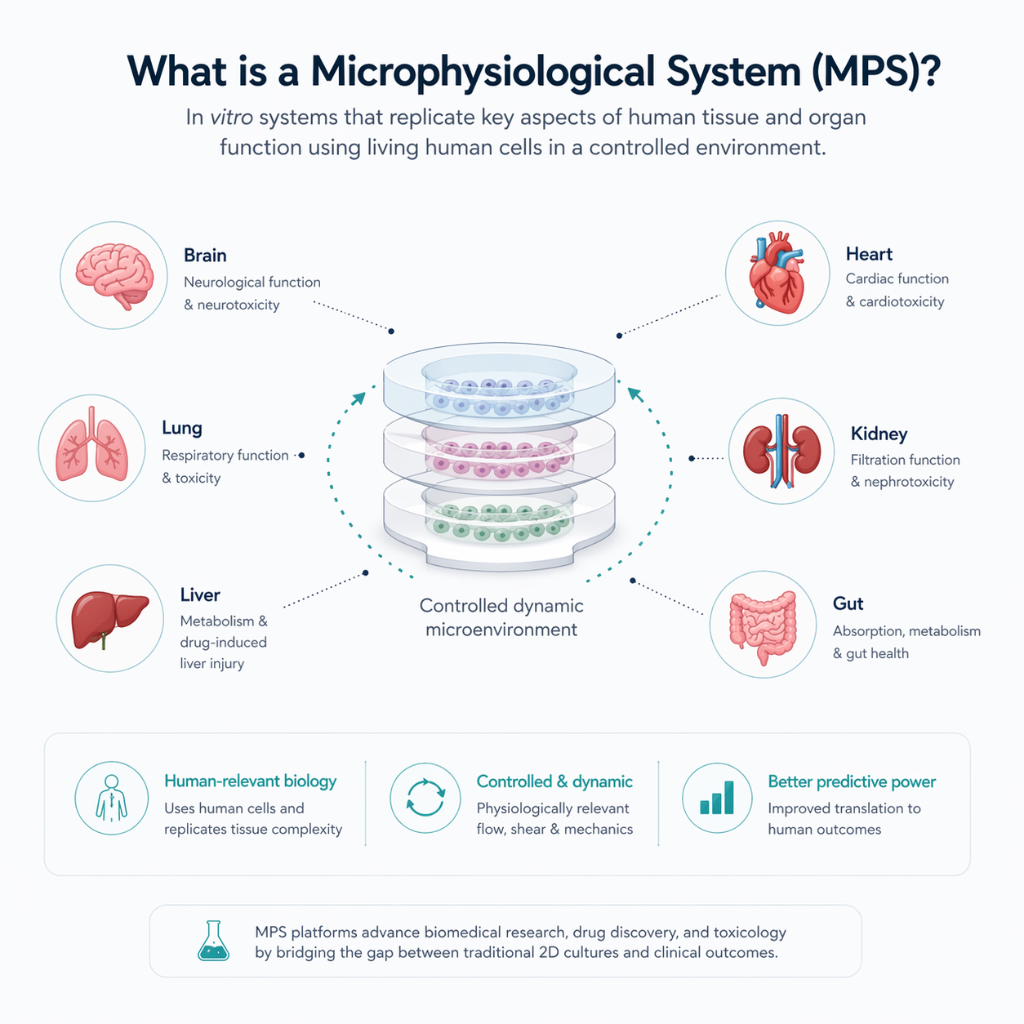
Fig. Schematic overview of a microphysiological system (MPS): human organ models connected to a controlled dynamic microenvironment. Not to scale.
On this page
Definition
What is a microphysiological system (MPS)?
A microphysiological system (MPS) is an in vitro platform designed to replicate key aspects of human tissue and organ function using living cells arranged in physiologically relevant architectures. These systems enable researchers to study drug response, toxicity, and disease mechanisms in a controlled, human-relevant environment.
Unlike traditional 2D cell cultures on flat dishes, MPS platforms incorporate multiple cell types, physiologically relevant tissue architecture, and — where applicable — dynamic culture conditions. Physiologically relevant shear can be introduced using orbital shaking rather than external pumps, reducing the complexity barrier for adoption.
The term is used interchangeably with organ-on-a-chip, tissue chip, and in vitro organ model — though they have subtle technical differences.
Key characteristics of an MPS
- Uses human-derived primary cells or iPSCs
- Supports co-culture of multiple cell types (e.g., hepatocytes + Kupffer cells)
- Maintains physiological cell-to-cell interactions
- Compatible with standard lab assays and readouts
- Designed to reduce or replace animal testing
Technology
How Does NANOSTACKS™ Compare to Traditional Organ-on-Chip?
What makes NANOSTACKS™ different from traditional organ-on-chip platforms?
Traditional organ-on-chip platforms use microfluidic devices with channels or chambers to house living human cells. They often require dedicated hardware, external pumps, specialized training, and clean-room fabrication — creating barriers to adoption in standard laboratories.
Revivocell's NANOSTACKS™ platform takes a different, more accessible approach: instead of microfluidic chips, it uses stackable modular inserts within standard 24-well plates. Physiologically relevant shear is generated via orbital shaking rather than external pumps, eliminating the need for specialist equipment while maintaining human-relevant biology.
Importance
Why MPS Matters for Drug Discovery
Why is human-relevant in vitro testing important?
Many drug candidates that show promise in preclinical testing do not translate successfully in human clinical studies, highlighting the need for more predictive, human-relevant models. A key contributing factor is that animal models have significant biological differences from humans — particularly in liver metabolism, immune response, and neurological function.
Human MPS platforms use human-derived cells in physiologically relevant architectures, making them fundamentally better predictors of human drug responses than either traditional cell culture or animal models.
What drug development problems does MPS solve?
- Hepatotoxicity prediction: Liver MPS models with hepatocytes, endothelial, immune, and stellate cells catch drug-induced liver injury (DILI) that flat cell cultures miss.
- Neurotoxicity assessment: Brain MPS with MEA-compatible electrode arrays can measure functional network activity — detecting sub-lethal neurotoxic effects invisible to viability assays.
- Multi-organ crosstalk: Multi-organ MPS systems model systemic effects — e.g., how a drug metabolized in the liver affects the brain or kidney.
Approach
Why Revivocell's Approach is Different
Most organ-on-chip platforms require dedicated microfluidic infrastructure, specialist operators, or custom fabrication. NANOSTACKS™ was designed from the ground up to remove these barriers.
What makes NANOSTACKS™ different
- Does not rely on complex microfluidics or external pumps
- Operates in standard SBS-format 24-well plates — compatible with existing lab workflows
- Modular stacking enables flexible system design: single-organ to multi-organ configurations
- Lower barrier to adoption compared to chip-based systems
- Validated protocols for culture durations of 14–28 days
For full technical specifications, see the NANOSTACKS™ Technology page.
Platform
How NANOSTACKS™ Works
What is the NANOSTACKS™ platform architecture?
NANOSTACKS™ is a modular, stackable insert system that fits into standard 24-well plates. Each insert represents a tissue layer — endothelium, parenchyma, immune cells, stroma — and stacks are assembled to build anatomically inspired multi-layer organ models.
Fluid flow is generated by orbital shaking rather than pumps, creating physiologically relevant shear stress without complex microfluidic hardware. This makes the platform compatible with any laboratory equipped for standard cell culture.
NANOSTACKS™ technical specifications
- SBS-format 24-well plate compatible
- Stackable PTFE/PC inserts — no pumps required
- Supports 2–4 cell layers per stack
- Validated for 14–28 day culture durations
- Compatible with: brightfield/fluorescence imaging, ELISA, qPCR, MEA, LC-MS/MS
- Available as ready-to-use kits or custom configurations
What organ models are available on NANOSTACKS™?
Revivocell currently offers validated models for liver, brain, and multi-organ systems. Each model is available in multiple configurations based on the complexity of cell co-culture required for the study.
Products
Available Organ Models
Liver MPS
Monoculture, triculture, and tetraculture configurations for ADME and hepatotoxicity studies.
Brain MPS
Neuronal co-culture with MEA compatibility for structural and functional neurotoxicity.
Multi-Organ MPS
Liver–brain, liver–kidney, and custom organ-axis systems for systemic toxicity.
Comparison
How Does MPS Compare to Other In Vitro Models?
MPS platforms sit between traditional 2D cell culture and animal models in terms of complexity and human relevance — and within MPS, different platform types (Transwells, organoids, organ-on-chip, NANOSTACKS™) each offer different trade-offs in control, throughput, and physiological fidelity.
Compare NANOSTACKS™ to other in vitro systems
Side-by-side table covering Transwells, organoids, organ-on-chip, and NANOSTACKS™ — with a decision guide for choosing the right model.
Applications
Who Uses MPS and For What?
Pharmaceutical companies
Early-stage ADMET screening, DILI prediction, reducing late-stage clinical failures.
CROs (Contract Research Organizations)
Offering human-relevant toxicology services to pharma clients.
Academic researchers
Disease modeling, mechanistic studies, and developing new assay methodologies.
AI drug discovery firms
Generating human-relevant training data for ML models predicting drug toxicity and efficacy.
Biotech startups
Validating lead candidates with human-relevant data before IND filing.
Regulatory agencies
Developing new evaluation frameworks as alternatives to animal testing (e.g., FDA Modernization Act 2.0).
Validation
Validated Applications
NANOSTACKS™ models have been validated across several toxicology and pharmacology applications:
Liver Toxicity (DILI)
Hepatocyte-based multi-culture models with sensitivity to drug-induced liver injury across metabolic and immune mechanisms.
Neurotoxicity
MEA-based functional readouts enabling detection of sub-lethal neurotoxic effects on neuronal network activity.
Multi-Organ Systems
Gut–liver and liver–brain axis models for studying systemic drug distribution, metabolism, and crosstalk.
Learn more or discuss your study
Talk to a scientist about your experimental requirements, or explore our platform and published resources.