



The pharmaceutical and biotech industries are undergoing a fundamental transformation. Driven by regulatory momentum, scientific evidence, ethical imperatives, and technological breakthroughs, organizations worldwide are transitioning from traditional animal models to New Approach Methodologies (NAMs)—a collection of innovative, human-relevant technologies that promise faster, more predictive, and more ethical drug discovery. This shift represents one of the most significant changes in drug development strategy in decades.
The Global Momentum: Regulatory Drivers Behind the Shift
For decades, animal testing was the gold standard because alternatives didn't exist. Today, that calculus has changed dramatically. The NIH, FDA, and regulatory agencies globally have signaled that the era of mandatory animal testing is ending.
In late 2022, the FDA Modernization Act 2.0 removed the federal requirement for animal testing for new drug protocols (FDA, 2022). By 2025, the NIH launched a comprehensive initiative supporting the development and validation of NAMs, providing substantial funding for human-based research technologies (NIH, 2025). The UK government also published a roadmap to phase out animal testing faster, coupled with investment in innovation hubs focused on NAMs validation (UK Government, 2025).
This convergence of regulatory signals creates a powerful incentive structure: companies that transition to NAMs earlier gain a competitive advantage in regulatory approval timelines.
Why Animal Models Fall Short: The Biological Challenge
The core challenge is biological.
For decades, drug development has relied on the assumption that safety and efficacy observed in animal models will translate to humans. While this approach has enabled significant advances, its limitations are increasingly recognised. A substantial proportion of drug candidates that perform well in animal studies fail to demonstrate the same outcomes in human clinical trials—reflecting, in part, fundamental biological differences between species (van Norman, 2019).
One key limitation lies in drug metabolism. Humans process compounds through enzymatic pathways that can differ significantly from those in commonly used animal models. A compound metabolised by CYP3A4 in humans may follow a different pathway in rodents, leading to discrepancies in both efficacy and toxicity profiles.
In parallel, traditional in vitro models such as 2D cell cultures lack critical features of human physiology. Without three-dimensional architecture, mechanical forces, and dynamic fluid flow, cells may not fully recapitulate in vivo behaviour.
The NAMs Toolkit: A Diverse Ecosystem
New Approach Methodologies encompass diverse technologies, each with distinct strengths:
-
Organoids: 3D tissue structures grown from stem cells. They offer high physiological relevance for disease modelling but face reproducibility challenges and lack fluid dynamics.
-
Organ-on-a-Chip: Microfluidic engineering that provides precise control over microenvironments and incorporates mechanical forces like blood flow. These platforms have advanced significantly over the past decade, though they require complex fabrication and can be difficult to scale (Low et al., 2021).
-
Microphysiological Systems (MPS): These represent a pragmatic middle ground. Platforms such as NANOSTACKS™ offer modular, human-relevant tissue constructs that layer multiple cell types with physiologically appropriate fluid dynamics while remaining compatible with standard 24-well lab infrastructure. Recent work has demonstrated their utility in studying barrier permeation across intestinal and brain compartments (Pavan et al., 2026).
NANOSTACKS™: A Case Study in Practical Implementation
To ground this discussion in a concrete example, consider an approach to NAMs design focused on reducing adoption barriers. Using modular, stackable human tissue constructs—layered hepatocytes, Kupffer cells, and endothelial cells—maintained in a pump-free bioreactor, scientists can replicate complex organ interactions relevant to drug-induced liver injury (DILI).
A peer-reviewed study by Talari et al. (2025) demonstrated that multicellular hepatic models using NANOSTACKS™ provide human-relevant predictions of drug response, supporting their utility in DILI screening and ADME studies.
Key design features include:
-
Standardisation: Using 15 mm diameter wells ensures compatibility with existing robotic dispensers and plate readers in standard 24-well format.
-
Physiological Flow: Orbital shaking generates defined shear stress levels, ensuring cells behave comparably to in vivo conditions.
-
Scalability: The platform's modular architecture supports both single-organ and multi-organ configurations without requiring specialised microfluidics expertise.
Integrated NAMs Workflow: From Discovery to Clinical Validation
The practical implementation of NAMs requires a systematic workflow that integrates multiple technologies and validates predictions against real-world clinical data. Biology-inspired microphysiological systems have been proposed as a framework for advancing patient benefit while reducing reliance on animal studies (Marx et al., 2020).
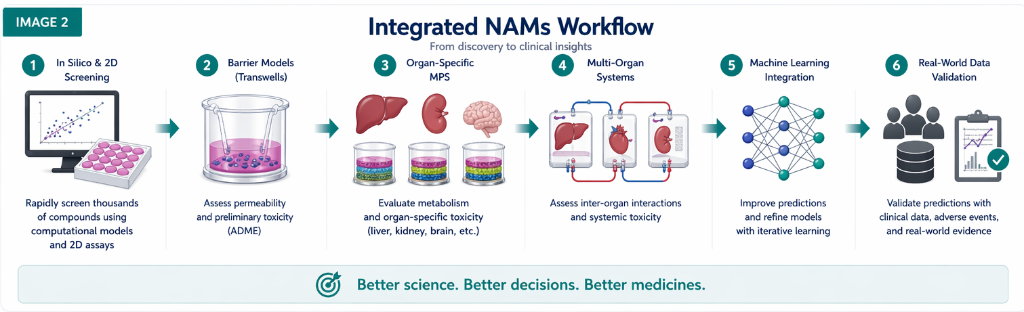
Figure 1. Integrated NAMs workflow from screening to clinical validation.
The workflow begins with rapid computational screening and 2D assays to prioritise lead compounds. Barrier models then assess initial permeability and toxicity. Organ-specific microphysiological systems evaluate metabolism and toxicity in relevant tissues (liver, kidney, brain). Multi-organ systems test inter-organ interactions and systemic effects. Machine learning algorithms integrate data across platforms to improve predictive accuracy. Predictions are then validated against real-world clinical data, adverse events, and post-market surveillance.
The Path Forward
By 2030, the industry is expected to converge on standardised panels of NAMs for routine preclinical screening. The future of preclinical testing is not a single platform, but an integrated ecosystem—combining human-relevant in vitro systems, computational models, and real-world data to make better predictions about drug safety and efficacy. Organisations that embrace this transition now will define the future of drug development.
References
-
National Institutes of Health (NIH). (2025). NIH to prioritize human-based research technologies.
-
U.S. Food and Drug Administration (FDA). (2022). FDA Modernization Act 2.0.
-
UK Government. (2025). Animal testing to be phased out faster as UK unveils roadmap for alternative methods.
-
Talari, A. C. et al. (2025). Multicellular hepatic in vitro models using NANOSTACKS™: human-relevant models for drug response prediction. In Vitro Models, 4(2), 131–144.
-
Pavan, B. et al. (2026). A new microphysiological platform to study the permeation of neuroactive agents across intestinal and brain barriers. Biofabrication, 18(2), 025013.
-
Low, L. A., Mummery, C., Berridge, B. R., Austin, C. P., & Tagle, D. A. (2021). Organs-on-chips: into the next decade. Nature Reviews Drug Discovery.
-
Marx, U. et al. (2020). Biology-inspired microphysiological systems to advance patient benefit and animal welfare in drug development. ALTEX.
-
van Norman, G. A. (2019). Limitations of animal studies for predicting human toxicity. Journal of the American College of Cardiology.