
Why Choose Our NANOSTACKS™ Liver Models?
Our NANOSTACKS™-based in vitro models recapitulate cell-cell crosstalk, fluid flow, and spatial cellular arrangement typical of the in vivo environment, delivering improved physiological relevance over traditional models.
Physiological Relevance Compared to Other Hepatic Models
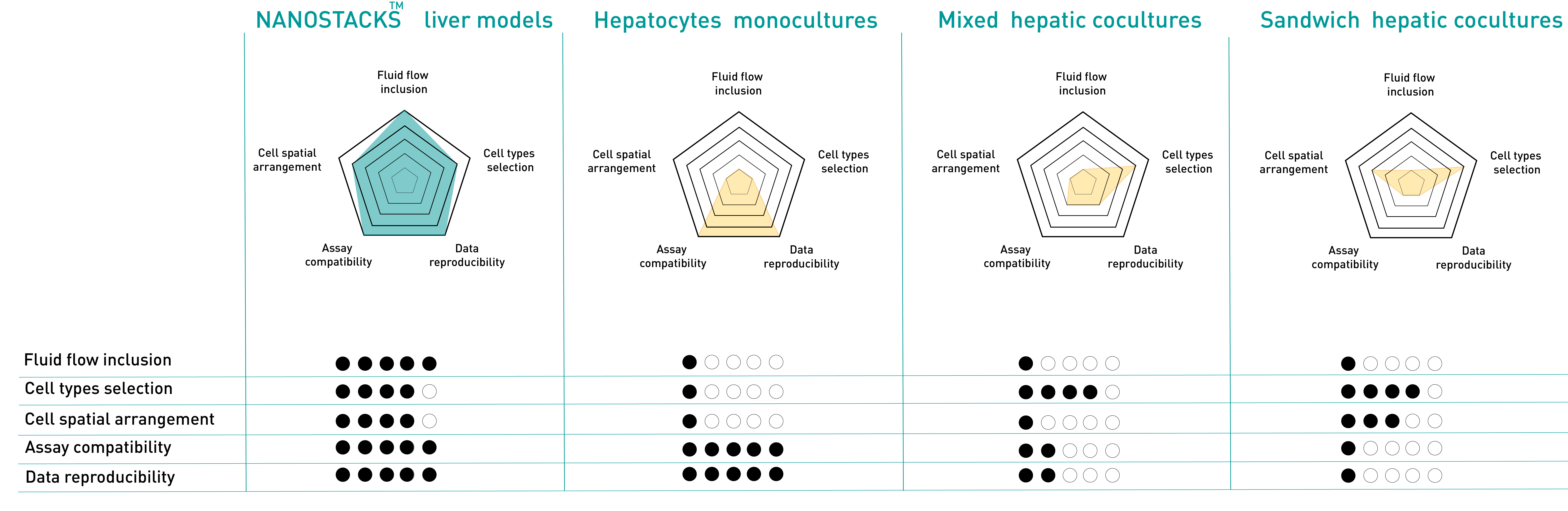
Integrate fluid flow and spatially accurate hepatic cell arrangement including the space of Disse, maintaining constant populations for improved reproducibility.
- •Fluid flow
- •Spatial accuracy
- •Constant populations
- •Isolatable layers
Widely used for ADME studies with consistent results, but lack cell-cell communication, spatial organization, and fluid flow.
- •Consistent results
- •Assay compatible
- •No cell crosstalk
- •No fluid flow
Mimic cell diversity but suffer from unpredictable cell proliferation and lack spatial organization and fluid flow.
- •Cell diversity
- •Poor reproducibility
- •No spatial control
- •No fluid flow
Offer partial spatial organization but lack the space of Disse, suffer from proliferation issues, and have no fluid flow.
- •Partial organization
- •No space of Disse
- •Complex structure
- •No fluid flow
Human Relevance of NANOSTACKS™
Unique Benefits
Key advantages of our NANOSTACKS™ technology
Human Relevance
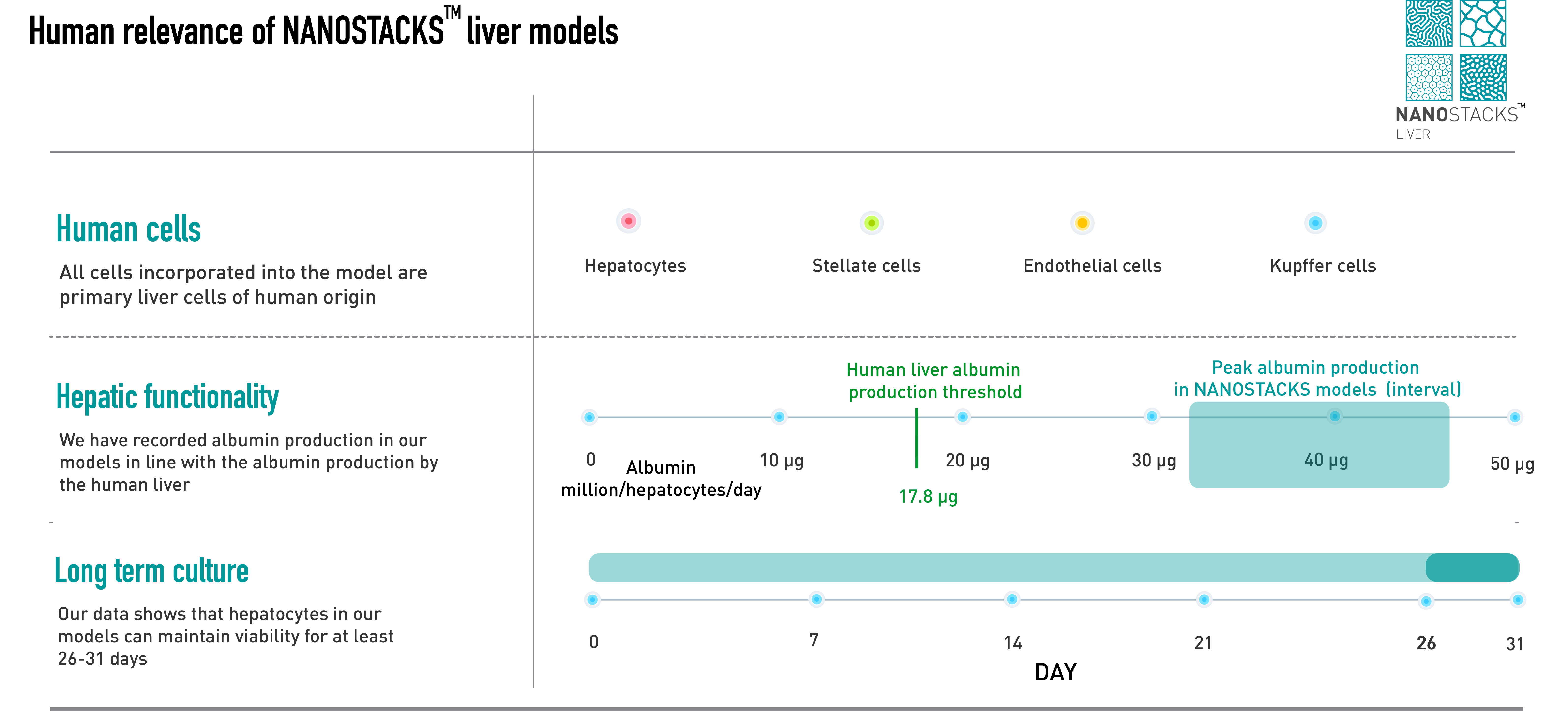
Developed entirely using primary human cells, ensuring translational value with consistent results.
Intercellular communication
Cell-cell crosstalk between key hepatic cells is replicated in the model, increasing its similarity to the in vivo environment.
Inclusion of fluid flow
Fluid flow can be included in the model, modelling the natural mechanical environment of the liver.
Differential toxicity evaluation
Toxicity can be evaluated on each individual cell type included in the model.
Long-term studies
Cells included the model are viable up to 31 days, providing the possibility to perform long-term toxicity screenings.
High quality cells
Our cells are obtained from trusted suppliers and consistently perform key hepatic functions.
Our NANOSTACKS™ Liver Models
Choose from validated monoculture, triculture, or tetraculture models tailored to your research needs

NANOSTACKS™ PHH Monoculture
Primary Human Hepatocytes (PHH)
Click any layer above to see details
Other endpoints available - contact us
Comprehensively Validated PHH Monoculture

Liver PHH Cells on NANOSTACKS™
Representative widefield images of primary human hepatocytes (PHH) in NANOSTACKS™. Magnification: 10X.
How to Access Our NANOSTACKS™ Liver Models
Choose the option that best fits your research needs