
Capabilities
What You Can Study
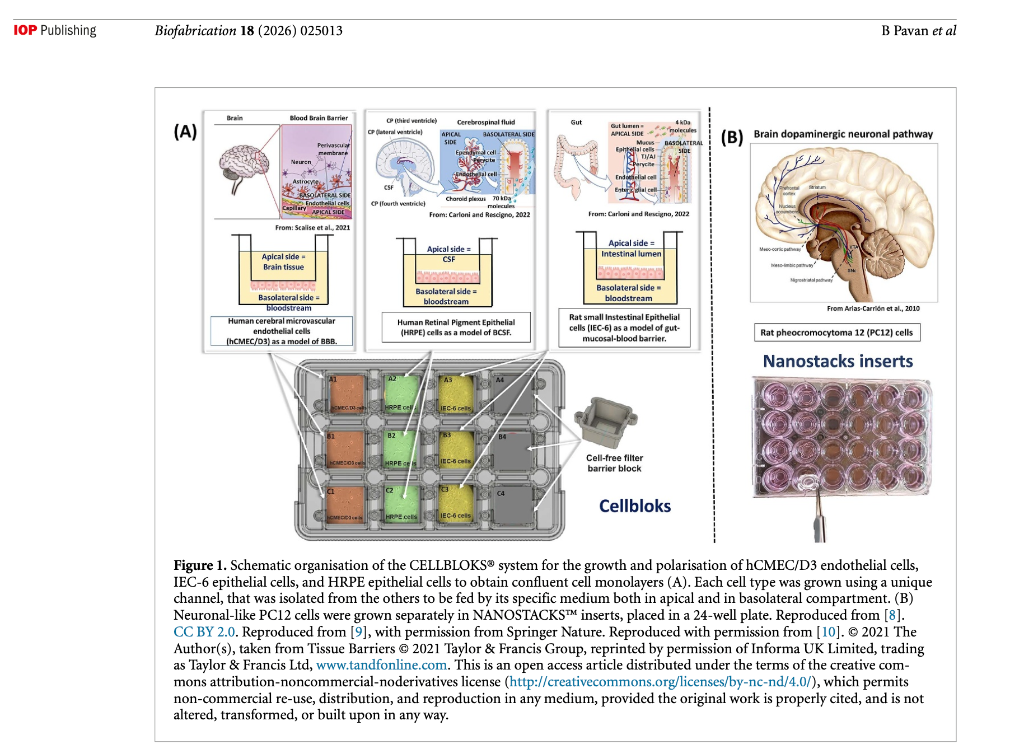
Three connected barrier interfaces — modeled in human cells, in a single integrated platform.
Intestinal Barrier (IB)
Absorption and first-pass transport
Model oral bioavailability and first-pass intestinal absorption using polarized human epithelial cell layers with validated tight junction formation.
Blood–Brain Barrier (BBB)
CNS penetration and permeability
Assess CNS drug penetration using a human brain endothelial barrier — with TEER readouts and efflux transporter activity relevant to CNS drug discovery.
Blood–CSF Barrier (BCSFB)
CSF exposure and neuroactive distribution
Evaluate compound distribution into the cerebrospinal fluid compartment — critical for understanding neuroactive exposure and CNS drug safety.
Context
Why This Matters
Traditional single-barrier models — or animal studies — fail to capture the sequential transport that determines whether a CNS compound will reach its target. Isolated permeability assays give partial answers. Only a connected, human-relevant system can accurately model the full absorption-to-CNS distribution pathway.
- Multi-barrier transport studied in one integrated system
- Human-relevant permeability data at each interface
- Mechanistic insight into CNS exposure and distribution
Connected Barrier Architecture
Human cells · Physiological architecture · Connected compartments
Process
How It Works
Compound Input
Your compound of interest is introduced at the intestinal apical surface — mirroring the oral absorption route.
Exposure Across Connected Barriers
The compound moves through the intestinal epithelium, into the systemic compartment, and is challenged against the BBB and BCSFB in a connected microphysiological system.
Measurement & Readouts
Barrier integrity (TEER), permeability coefficients, transport ratios, and compartment concentrations are measured at each interface.
AI-Assisted Interpretation (Optional)
Pattern recognition across multi-barrier datasets to support mechanistic hypothesis generation and predict CNS exposure profiles.
Deliverables
What You Get
- Barrier-specific permeability coefficients (Papp, Pe)
- Cross-barrier transport profiles across IB → BBB → BCSFB
- TEER measurements for barrier integrity at each interface
- Mechanistic insights into CNS exposure and distribution
- Human-relevant validation grounded in peer-reviewed methodology
Scientific Validation